Monday, August 6, 2012
A button-sized success.
These tiny button-sized scarlet balls represent a gardening milestone for me. My first ever cherry tomatoes, grown without sprays or chemicals, in the dead of winter!
This time last year I had invested in a small four tiered plastic covered greenhouse with good intentions of using it to raise seeds for that coming summer. Unfortunately my complete lack of understanding about the principles behind greenhouse seed raising lead to a production of crispy brown seedlings (note to self: leaving a greenhouse completely closed in the Australian summer will lead to temps above 50oC).
This winter, having invested in a much larger greenhouse (and some informal education on the matter) I have had success with raising seeds.
This tomato plant grew from seeds dropped after last summers crop. I think the variety was called "Tiny Tom". The fruits small size is due to the plant having to grow in a smaller than ideal pot, as space in my greenhouse is limited.
While two tiny tomatoes really does not even qualify for a salad for one, it is an indicator to me that in gardening, anything is possible.
Thanks everyone for your lovely comments to my last post, they are really appreciated :-)
Sam xox
Sunday, August 5, 2012
The marvels of modern medicine.
Nerves got the better of my blog posting this week as I prepared for keyhole heart surgery, which was done on Friday. Fortunately it went smoothly with no complications, much to my relief. I am completely in awe of modern medicine after having the procedure done. I was awake for the entire two hours, as the doctors burned off a bit of misfiring electronics within my heart muscle using wires threaded through my a vein near my hip. I even got to request the music I listened to while it was done. It was a full on experience, and felt pretty much as it sounds. But I am thrilled to bits to have had it done and wait to see that it fixed the problem.
I am couch bound for the coming days, with strict instructions not to do any heavy lifting. So gardening is out for me until the later half of the week, which means Jamie will get the honour of harvesting our first broccoli.
In commemoration of my hearty experience this week, I thought I would talk about the tomato "Oxheart". This tomato is an heirloom variety which also runs under the name "Bullock's Heart" and "Coeur de Boeuf" in other countries. It bears a red/pink heart-shaped fruit that has a shiny, almost polished, appearance.
The perfect tomato for creating rich tomato-based sauces, chopping into thick meaty slices for burgers, or pairing with mozzarella and basil for a light snack.
Sam xox
Tuesday, July 31, 2012
The Fitzroy Inn.
This weekend I was lucky enough to visit the Fitzroy Inn, an historic property nestled in the Southern Highlands of New South Wales. There is a rich history to be discovered here, dating back to 1836 when the main building was first opened as a travellers inn. Since then it has been home to travellers, convicts, and school children. The very first tennis court in Australia was even built on these very grounds! This was a fitting venue for the celebration of a special family occasion...
A very special "thank you" to 'the lovely Paul and Maria, who welcomed us all with such heartfelt hospitality, and made the day simply perfect.
If you are ever passing through the Southern Highlands, I would definitely recommend visiting this place.
Sam xox
Wednesday, July 25, 2012
Green Harvest package arrives.
Arriving home from work today I found a large package waiting for me at my doorstep. "Green Harvest". My seeds! I had only placed the order 48 hours prior. Speedy service!
Here are my goodies...
Included in the package were some Green Harvest resource guides. I ordered a few extra to give to fellow vegetable growing enthusiasts!
I also ordered some of their trade mark Clucker Tucker. This is a mixture of 13 different types of seeds (including bok choy, clover, silverbeet and millet). I am going to plant out the seeds in seed trays and once they have sprouted to a decent length, put the tray into the coop and let the chooks eat it all up. I will plant a tray every week so that I will have a continuous cycle of Clucker Tucker. Once one tray is eaten it will be planted out again. The package advises that 1g - 2g of seeds will cover one seed tray. So 250g should last me a fair while.
I bought a wide variety of seeds. I ensured that I purchased seeds that were heirloom varieties and organically certified where possible.
And I even invested in Jackie French's "Guide to Companion Planting". It came with three packets of seeds: Good Bug Mix (perfect for growing flowers that attract the good bugs to your garden), Mustard 'Reg Giant', and Nasturtium 'Jewel Mix'.
Sophie was gobsmacked by the value I got for my money.
If you're interested, here is the list of seeds I purchased:
* Bean Bush - Italian Romano
* Bean Climbing - Northeaster (organic)
* Bean Bush - Royal Burgundy (organic)
* Capsicum California Wonder (organic)
* Carrot colour mix (organic)
* Cucumber Spacemaster Bush
* Eggplant Little Finger (organic)
* Eggplant Casper
* Radish Watermelon
* Silverbeet Fordhook Giant (organic)
* Tomato Cherry Red Pear (organic)
* Tomato Green Zebra (organic)
* Tomato Rouge de Marmande (organic)
* Zucchini Costa Romanesque
Sam xox
Tuesday, July 24, 2012
An unbelievable swap.
I have made friends with a lady at the Spinning and Weaving Guild I joined earlier this year. She is super friendly and very generous with her time and advice (some of her work you can see on her blog Flashion Fibres). When I attended my first Guild meeting I was a complete beginner. Full of good intentions and keen interest, but lacking in any skill, knowledge or experience. She took time to show me her spinning wheel, spoke about her creations, and was really encouraging when I spoke about my enthusiasm to learn to spin. I was spurred on by her kind words.
During the weeks that followed our first meeting, I found a 40+ year old spinning wheel on ebay for under $100 (a bargain as far as operating spinning wheels go). It arrived by post and after some handy work by dear hubby my wheel ran smoothly. Thanks to YouTube I was able to teach myself how to spin. It took almost three weeks for my muscle memory to kick in. Once my body had learnt the technique it was all smooth from there.
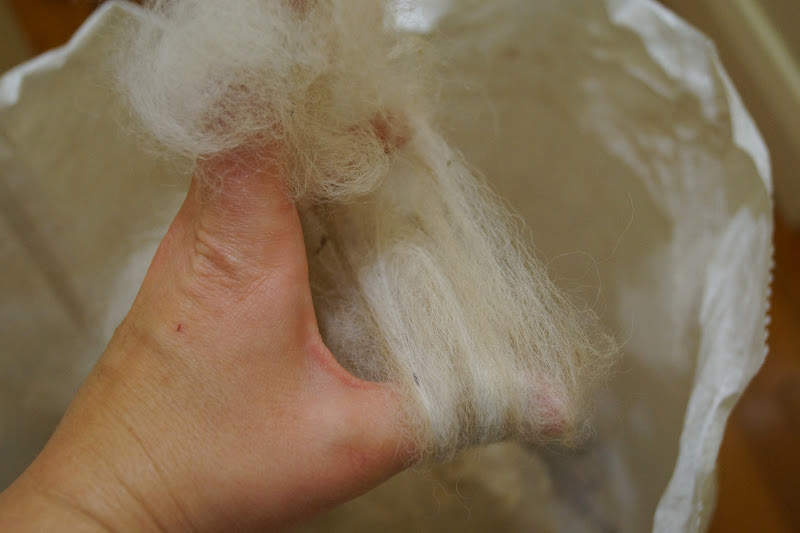
A week ago this same friend contacted me to offer an alpaca fleece. She occasionally receives fleeces, and likes to give some of them to beginners in the Guild. Alpaca fibres are silky natural fibres that are a pleasure to handle. Compared to wool, the fibres are warmer, do not itch, and are hypo-allergenic as they do not have any lanolin.
I insisted that I wanted to gift her something in return, so we agreed upon a dozen of my chickens eggs, six of my ducks eggs and a bag of snow peas picked straight from my garden. She loved her care package, as did I...
~ The fibres stretched out ~
~ I cannot describe to you how soft this fleece is ~
This has been one of my favourite trades yet! What sorts of home made / home grown things have you traded?
Sam xox
Sunday, July 22, 2012
Broccoli.
Way back in autumn I planted some broccoli seedlings in one of the shadiest parts of my veggie patch. They grew so slowly that I was beginning to worry that I might not get to eat home grown broccoli this growing season. As brassicas are such heavy feeders, I had to keep the food up to them and this took a bit of work. They dinned on compost, chook manure, and fertiliser for almost three months.
All the feeding has paid off, as last weekend I discovered that those familiar green trees were beginning to appear...
Sam xox
Friday, July 20, 2012
Seed to seed.
There is something a little sneaky going on at your local gardening super store. Most of the packets on the shelves contain F1 seeds. These are varieties of plants produced under controlled circumstances, where two species of plant are interbred, usually to combine their desirable characteristics (eg. disease resistance, high crop yield). F1 seeds are the 'children' produced by the joining of the two plants.
So why is this so sneaky? Because the seeds produced by F1 plants cannot be saved as the seeds will never 'come true' (they are sterile). This means that every year (or more) you will need to buy more and more seeds to regrow your crops (meaning more and more cash for the big stores!).
What can be done about this? Well, that is where heirloom (also known as heritage) seed varieties come in. These are seed varieties that have been past down through generations of seed savers and have stood the test of time.
Seed saving is a cost effective way of ensuring you have good yields year after year. As the years pass, the plants become accustomed to the local climate and soil conditions. Plants that produce a high yield and prove to be most disease resistant are preserved in the form of tiny seeds for future plantings.
My goal for this Spring is two fold. Firstly, I want to plant out all my summer crop from heirloom seed varieties purchased from small companies, and organic where possible. Secondly, at the end of Summer I want to save the seeds and keep them for the following Spring (and gift some to fellow veggie gardeners in the family!). However, my seed saving knowledge is very limited, and I do not want to spend the next 5 years gaining knowledge purely through trial and error. For this reason I have decided to take a 'short cut' and purchased this book...
Seed to Seed: Seed Saving and Growing Techniques for Vegetable Gardeners
By Suzanne Ashworth
There are over 70 positive reviews on Amazon regarding this book. So I relied on these reviews and purchased it online sight unseen. It should hopefully arrive within the next fortnight. The majority of the reviewers commented on the thoroughness of the information the book provided, so I am hopeful.
Tonight I will place my order with Green Harvest (recommended to me in a recent blog post by frogdancer - thank you for the tip!). I will be ordering only heirloom varieties, organic where possible.
Do you save seeds? Do you have any tips for me?
Sam xox
Subscribe to:
Posts (Atom)